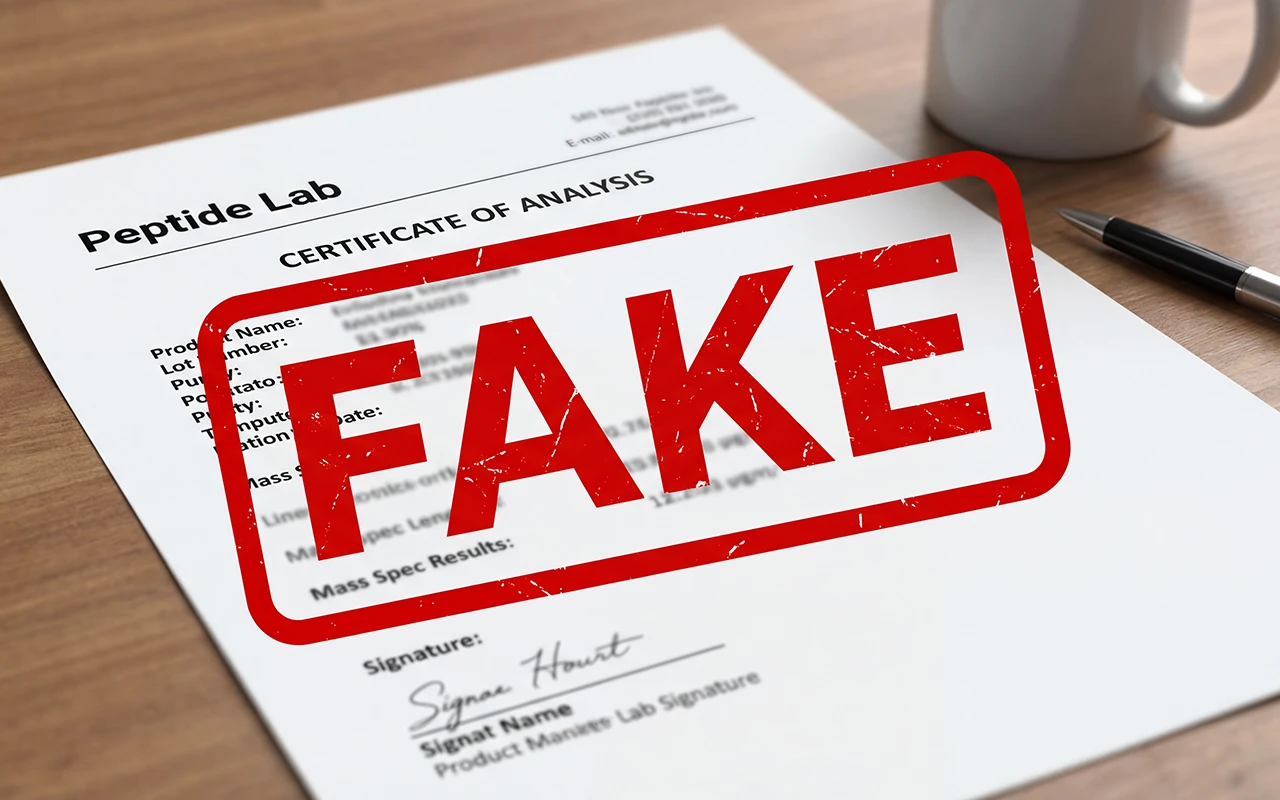
The UK peptide market is currently unregulated. This means anyone can buy a bag of white powder from Alibaba, put it in a vial, label it "99% Pure," and sell it to you.
To combat this, smart buyers look for a COA (Certificate of Analysis). This is a lab report from an HPLC machine that verifies purity.
But here is the problem: Vendors are faking them.
We have identified three common scams used by UK suppliers to trick you into thinking their product is tested when it isn't.
Scam 1: The "Factory Report"
If the COA on the website has a Chinese header or looks like it came from the manufacturer, it is worthless.
Chinese factories will simply print "99%" on every report they send, regardless of what is in the box. A legitimate UK supplier must pay for Third-Party Independent Testing from an accredited laboratory after the product arrives in the UK.
Scam 2: The "Photoshop Job"
Look closely at the PDF. Does the "Date" font look slightly different from the rest of the text? Is the "Batch Number" slightly blurry?
Shady vendors will take one good test result from 2023 and simply photoshop the date to "Jan 2026" every month. If the document looks manipulated, heavily pixelated, or the fonts don't match, walk away.
Scam 3: The "Bait and Switch"
Some vendors will test one single vial to get a perfect report. They post that report online. Then, they fill the rest of the 5,000 vials with cheap, under-dosed filler.
While this is harder to spot, the solution is to look for Batch Numbers. The Batch Number on the COA must match the Batch Number printed on the vial you receive. If your vial has no number, or a different number, the test means nothing.
⚠️ The "Match" Rule
You don't need to be a scientist to verify a product. You just need to check these three things:
- The Date: Is the report recent (within the last 6-12 months)?
- The Batch Code: Does the code on the paper match the sticker on the bottle?
- The Product Name: Does the chemical name match exactly?
If a vendor sends you a vial with no Batch Number on it, they are preventing you from checking. That is the biggest red flag of all.
Why Purity Matters (It's Not Just Potency)
You might think, "Who cares if it's 95% pure instead of 99%?"
The issue isn't the 95% peptide; it's the 5% Unknown. In cheap manufacturing, that 5% can be heavy metals, TFA (trifluoroacetic acid) salts, or bacterial endotoxins. Injecting these impurities causes severe inflammation, welts, and immune reactions.
The Verdict
Trust is earned, not claimed. If a supplier hides their lab reports, makes them difficult to read, or uses generic factory PDFs, walk away.
Your research subjects deserve medical-grade purity. Always verify the batch.
Disclaimer: This article is for educational purposes on quality control standards. Always conduct your own due diligence.